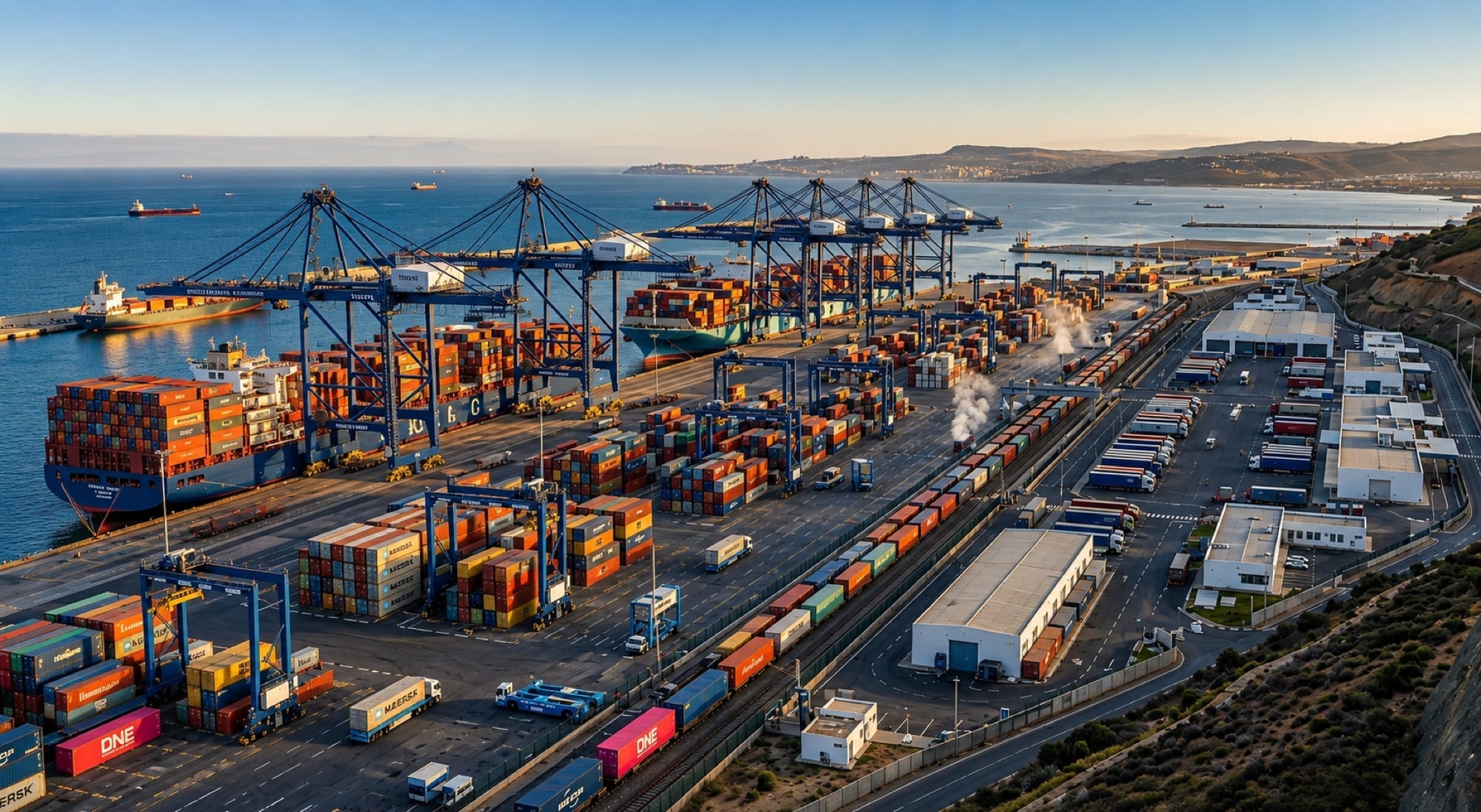
Pillar 03 · Trade Policy
Free Trade Agreements & Market Access
Executive Summary
No other market combines Morocco's specific set of trade agreements: a EU Association Agreement in force since 2000, a comprehensive US FTA since 2006 eliminating tariffs on 95% of bilateral trade, an EFTA agreement since 1999, the intra-regional Agadir Agreement with Egypt, Jordan and Tunisia, and — since ratifying in 2019 — membership in the African Continental Free Trade Area. Manufacturers who export duty-free (or near duty-free) to the EU and the US from a single production base, while also holding a foothold in the AfCFTA's still-forming continental market, are running a genuinely differentiated logistics strategy, not a marketing claim.
Key Takeaways
- Morocco holds preferential trade agreements with 62 countries in total.
- The EU Association Agreement (2000) and US FTA (2006, 95% tariff elimination) give simultaneous access to both major Western markets.
- The Agadir Agreement and EFTA agreement extend preferential access to Arab and wider European trading partners.
- AfCFTA (ratified 2019) offers continental optionality, but implementation is still uneven by trading partner.
- The EU Association Agreement's territorial scope excludes Western Sahara following an October 2024 CJEU ruling.
Key Facts
EU Association Agreement
Tariff elimination on industrial goods phased over 12 years
US-Morocco FTA
Tariffs eliminated on 95% of bilateral consumer/industrial trade
EFTA Agreement
Iceland, Liechtenstein, Norway, Switzerland
AfCFTA
African Continental Free Trade Area
The EU Association Agreement: the market that matters most
The EU-Morocco Euro-Mediterranean Association Agreement, in force since 2000, created a free trade area for industrial goods between Morocco and the European Union, with tariffs phased out over 12 years, and duty-free access for a defined quota of agricultural and seafood products.
The EU remains Morocco's largest trading partner by a wide margin, and this agreement is the underlying reason the automotive and aerospace supply chains covered in the Industrial Ecosystem pillar chose Morocco as an EU-facing production base rather than a purely domestic or regional one.
The US-Morocco Free Trade Agreement
In effect since 2006, the US-Morocco FTA eliminated tariffs on 95% of bilateral trade in consumer and industrial products and is comprehensive in scope, with chapters covering intellectual property rights, labor standards and environmental protection — the template the US uses for its more rigorous trade agreements.
For US-headquartered manufacturers and their supply chains, this is one of very few agreements giving simultaneous preferential access to both the EU and US markets from the same African production base.
Regional agreements: Agadir and EFTA
The Agadir Agreement, signed in Rabat in February 2004 and in force since March 2007, creates a free trade area between Morocco, Egypt, Jordan and Tunisia — a smaller, more targeted arrangement than pan-regional blocs, aimed at building intra-Arab trade volume.
Separately, Morocco has held a free trade agreement with the European Free Trade Association — Iceland, Liechtenstein, Norway and Switzerland — since 1999, extending preferential access beyond the EU-27 to the rest of the European Economic Area's trading partners.
AfCFTA: the market still being built
Morocco's government council adopted the bill ratifying the African Continental Free Trade Area agreement in February 2019, formalizing its participation in what is intended to become the world's largest free trade area by member count once fully implemented.
AfCFTA's tariff-reduction schedules and rules of origin are still being phased in across the continent, unevenly by country — investors should treat this as a market under construction with real optionality, not yet a fully realized single market with the certainty of the EU or US agreements.
Diligence note
AfCFTA implementation varies significantly by trading partner country. Confirm current tariff schedules for the specific destination market before pricing an AfCFTA-dependent export model.
Market Outlook
Expect the EU and US agreements to remain the commercially decisive ones through 2030, while AfCFTA implementation gradually deepens — worth revisiting annually rather than treating as a fixed input. The Western Sahara ruling's practical scope may also continue to evolve through further EU institutional and judicial action.
“AfCFTA gets treated as if it were already one market. It isn't yet — model it country by country, or you'll price an export strategy against an agreement that hasn't finished phasing in.”
— WE ARE TOGETHER Research Desk
Timeline
1999
EFTA Agreement
Free trade agreement with Iceland, Liechtenstein, Norway and Switzerland.
2000
EU Association Agreement
Free trade area for industrial goods with the European Union enters into force.
2004 / 2007
Agadir Agreement signed / in force
Regional FTA with Egypt, Jordan and Tunisia.
2006
US-Morocco FTA
Tariffs eliminated on 95% of bilateral consumer and industrial trade.
2019
AfCFTA ratified
Morocco formalizes participation in the African Continental Free Trade Area.
- Simultaneous preferential access to the EU and US markets from one production base — a rare combination globally
- 62 countries in total hold preferential trade agreements with Morocco
- AfCFTA membership positions Morocco early in a still-forming continental market
- US FTA's comprehensive IP, labor and environmental chapters reduce compliance surprises for US-listed multinationals
Case Studies
Renault Group Morocco
Automotive export manufacturing
Renault's Tangier and Casablanca plants export the large majority of production to Europe, a flow structured directly around the EU Association Agreement's tariff terms — detailed further in the Industrial Ecosystem pillar.
Frequently Asked Questions
Sources
- European Commission, Trade — EU-Morocco Association Agreement
- US Trade Representative / Trade.gov — US-Morocco Free Trade Agreement
- bilaterals.org — Agadir Agreement text and status
- African Union / AMDIE — AfCFTA ratification status, Morocco
Figures reflect the most recently published data at the time of writing. Confirm current values directly with the cited institution before relying on them for a specific transaction.
Ready to act on free trade agreements & market access?
Every pillar in this knowledge center connects to a real next step — not just more reading.
Related Sectors
Related Cities